

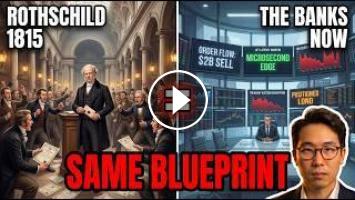
On June 20th, 1815, Nathan Mayer Rothschild stood at his pillar in the Royal Exchange holding a courier dispatch from the continent — Wellington had won at Waterloo. He began selling British consols. Other traders, reading his position as a signal of bad news, sold alongside him. Prices collapsed. Then Nathan bought everything available at the panic bottom. Two days later, official dispatches confirmed what his couriers had told him thirty-six hours earlier. The profit from a single trading sequence, built on a thirty-six-hour information edge his family had spent years and significant capital deliberately building, became the foundation of one of history's most powerful private financial dynasties.
Today's largest banks maintain the modern equivalent of that infrastructure at a scale Nathan Rothschild could not have imagined.
Proprietary order flow visibility shows institutional sell orders before they hit the open market. HFT co-location reduces execution gaps from milliseconds to microseconds. Primary dealer status in Treasury auctions provides structural access to sovereign debt markets that no other participant possesses. Goldman Sachs paid $550 million in 2010 to settle SEC allegations that it sold mortgage securities to clients while betting against them internally — the 1815 pattern documented officially, resolved without an admission of wrongdoing, and without addressing the structural incentive that made the behavior possible. With $9 trillion in Treasury debt requiring refinancing in 2025 and $3 trillion in corporate debt facing rate stress, the liquidation event that activates the blueprint's full advantage is no longer a tail risk. It is the arithmetic of the calendar.
What You'll Learn:
▸ What Nathan Rothschild actually did at the Royal Exchange in 1815 — and which parts of the story are documented versus legend
▸ The three structural components of the Rothschild blueprint: information first, ambiguous communication, and scale large enough to be a market maker
▸ How proprietary order flow gives large banks structural visibility into institutional trades before they execute
▸ What HFT co-location actually is — and why microsecond advantages in order execution replicate the courier network's function
▸ What the 2010 Goldman Sachs SEC settlement documented about the modern blueprint's operation
▸ Why liquidation events specifically widen the information gap that the blueprint exploits — and how this applies to 2025's debt refinancing calendar
▸ Why JPMorgan's simultaneous role as proprietary trader, primary dealer, and counterparty makes the 2025 version structurally different from 1815
The Timeline:
1815 — Nathan Rothschild's Waterloo trade at the Royal Exchange; courier network information advantage documented
1800s-1900s — Rothschild family builds five-city European banking network on information infrastructure advantage
1970s — Program trading begins; early computerization of order execution
1990s — Electronic trading platforms replace physical trading floors; speed advantages begin compounding
2000s — HFT firms emerge; co-location near exchange servers begins
2010 — Goldman Sachs pays $550 million SEC settlement over Abacus mortgage securities
2014 — Flash Boys published; HFT front-running documented for mainstream audience
2020 — Federal Reserve hires BlackRock and other asset managers to execute emergency bond purchases
2024 — $9 trillion in U.S. Treasury debt identified as requiring 2025 refinancing
2025 — Corporate debt refinancing wall, Treasury auction stress, and regional bank losses converge
Nathan Rothschild's courier arrived thirty-six hours before the official dispatches. The banks' information edge in 2025 arrives in microseconds. The blueprint is the same.
Subscribe to see the structure beneath the headlines before it becomes consensus.
Today's largest banks maintain the modern equivalent of that infrastructure at a scale Nathan Rothschild could not have imagined.
Proprietary order flow visibility shows institutional sell orders before they hit the open market. HFT co-location reduces execution gaps from milliseconds to microseconds. Primary dealer status in Treasury auctions provides structural access to sovereign debt markets that no other participant possesses. Goldman Sachs paid $550 million in 2010 to settle SEC allegations that it sold mortgage securities to clients while betting against them internally — the 1815 pattern documented officially, resolved without an admission of wrongdoing, and without addressing the structural incentive that made the behavior possible. With $9 trillion in Treasury debt requiring refinancing in 2025 and $3 trillion in corporate debt facing rate stress, the liquidation event that activates the blueprint's full advantage is no longer a tail risk. It is the arithmetic of the calendar.
What You'll Learn:
▸ What Nathan Rothschild actually did at the Royal Exchange in 1815 — and which parts of the story are documented versus legend
▸ The three structural components of the Rothschild blueprint: information first, ambiguous communication, and scale large enough to be a market maker
▸ How proprietary order flow gives large banks structural visibility into institutional trades before they execute
▸ What HFT co-location actually is — and why microsecond advantages in order execution replicate the courier network's function
▸ What the 2010 Goldman Sachs SEC settlement documented about the modern blueprint's operation
▸ Why liquidation events specifically widen the information gap that the blueprint exploits — and how this applies to 2025's debt refinancing calendar
▸ Why JPMorgan's simultaneous role as proprietary trader, primary dealer, and counterparty makes the 2025 version structurally different from 1815
The Timeline:
1815 — Nathan Rothschild's Waterloo trade at the Royal Exchange; courier network information advantage documented
1800s-1900s — Rothschild family builds five-city European banking network on information infrastructure advantage
1970s — Program trading begins; early computerization of order execution
1990s — Electronic trading platforms replace physical trading floors; speed advantages begin compounding
2000s — HFT firms emerge; co-location near exchange servers begins
2010 — Goldman Sachs pays $550 million SEC settlement over Abacus mortgage securities
2014 — Flash Boys published; HFT front-running documented for mainstream audience
2020 — Federal Reserve hires BlackRock and other asset managers to execute emergency bond purchases
2024 — $9 trillion in U.S. Treasury debt identified as requiring 2025 refinancing
2025 — Corporate debt refinancing wall, Treasury auction stress, and regional bank losses converge
Nathan Rothschild's courier arrived thirty-six hours before the official dispatches. The banks' information edge in 2025 arrives in microseconds. The blueprint is the same.
Subscribe to see the structure beneath the headlines before it becomes consensus.
- Категория
- Схемы по заработку в интернете

Комментариев нет.
Следующее
Auto
-
58:22

Rothschild, le pouvoir d'un nom
-
36:33
Building the Database for Trillion-Scale AI Search
-
50:07
The $100 Trillion Crypto Trade After AI | Jordi Visser
-
10:56
The $1 Trillion Treasury Bombshell: Is Gold About to Be Revalued?
-
10:38
A $1.5 Trillion Wall Street Giant Just Launched An XRP ETF
-
11:49
I Tried PewDiePie's Trillion Dollar AI App - His Own ChatGPT (For Free, Forever)
-
11:35
MY Clickbank (100 To 1,000/Day) Affiliate Marketing Blueprint For Beginners
-
16:59
The $2 Trillion Lending Industry Most People Have Never Heard Of
-
10:42
XRP Holders, A $1.6 TRILLION Bank Just Made Its Move
-
20:51
$100 Trillion Crypto Thesis: The Actual Math
-
05:33

ЗАРАБОТОК В ИНТЕРНЕТЕ | КРУТАЯ СХЕМА | FUNPAY
-
08:12

Пассивный Заработок 1000Р в День в Интернете на Телефоне Без Вложений
-
06:43

Как ЗАРАБОТАТЬ ШКОЛЬНИКУ в ИНТЕРНЕТЕ? Самые Легкие Способы Заработка
-
07:05

ЗАРАБОТОК В ИНТЕРНЕТЕ 2023 | Реальный заработок в интернете с вложением | Как заработать в интернете
-
05:49

ЗАРАБОТОК В ИНТЕРНЕТЕ 2023 | Реальный Заработок В Интернете С Вложением. Как Заработать В Интернете?
-
04:28

Схема заработка 2023 ! Зарабатываем в интернете онлайн сидя дома ! Заработок денег ! Деньги легко !
-
05:33

ЗАРАБОТОК В ИНТЕРНЕТЕ | КРУТАЯ СХЕМА | FUNPAY
-
06:43

Как ЗАРАБОТАТЬ ШКОЛЬНИКУ в ИНТЕРНЕТЕ? Самые Легкие Способы Заработка
-
14:53

Показываю Как Зарабатывать Деньги - Заработок В Интернете 2023 Рабочая Схема Для Заработка
-
14:12

Большой Заработок В Интернете С Выводом Рабочая Схема Заработка
 Загрузка...