

In the ecosystem of modern and traditional agriculture, the meticulous management of livestock feed remains a foundational element for sustainable rural productivity. Farmers continually utilize time-tested manual techniques to harvest high-yield forage crops, ensuring a reliable, nutrient-rich supply for farm animals while maintaining careful stewardship of agricultural lands.
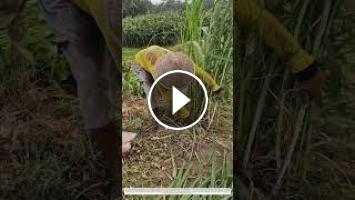
The video captures a tranquil yet intensive agricultural scene in an open rural field, focusing on a dedicated farm worker harvesting tall green forage grass. The sequence begins with an agricultural worker dressed in a yellow long-sleeve shirt, light shorts, sandals, and a traditional conical bamboo hat (caping) standing amidst dense clusters of tall green grass. Holding a sharp, curved steel sickle in hand, the operator swings the blade rhythmically near the base of the stems, cleanly slicing through the thick stalks with practiced precision. As the work progresses, individual clumps are systematically cut down, falling neatly onto the soil surface to form growing piles of fresh green fodder, ready for collection and transport.
Visually, the core instrumentation relies purely on manual ergonomics and classic agricultural hand tools. The primary instrument is a forged steel sickle featuring an ergonomic wooden handle and a curved blade profile optimized for pulling and slicing vegetation close to the ground. The operator leverages leverage and upper-body coordination to execute clean cuts without damaging the root system, allowing the forage to regenerate successfully for future harvests. The surrounding environment showcases fertile soil beds and adjacent crop rows, emphasizing a deeply authentic, hands-on farming lifestyle.
This traditional yet highly efficient harvesting method brings profound productivity and economic benefits to smallholder farming systems. By utilizing manual hand tools, farmers avoid heavy fuel costs while maintaining absolute control over cutting precision, minimizing waste, and selecting only the prime portions of the crop. Furthermore, securing a fresh, high-quality daily supply of nutritious forage directly supports livestock health, milk production, and overall farm profitability without requiring complex machinery.
Ultimately, this process offers an inspiring philosophical reflection on the harmony between human labor and traditional implements. It demonstrates how enduring skills passed down through generations can transform simple, unrefined field growth into essential resources that sustain rural livelihoods and agricultural traditions alike.
The video captures a tranquil yet intensive agricultural scene in an open rural field, focusing on a dedicated farm worker harvesting tall green forage grass. The sequence begins with an agricultural worker dressed in a yellow long-sleeve shirt, light shorts, sandals, and a traditional conical bamboo hat (caping) standing amidst dense clusters of tall green grass. Holding a sharp, curved steel sickle in hand, the operator swings the blade rhythmically near the base of the stems, cleanly slicing through the thick stalks with practiced precision. As the work progresses, individual clumps are systematically cut down, falling neatly onto the soil surface to form growing piles of fresh green fodder, ready for collection and transport.
Visually, the core instrumentation relies purely on manual ergonomics and classic agricultural hand tools. The primary instrument is a forged steel sickle featuring an ergonomic wooden handle and a curved blade profile optimized for pulling and slicing vegetation close to the ground. The operator leverages leverage and upper-body coordination to execute clean cuts without damaging the root system, allowing the forage to regenerate successfully for future harvests. The surrounding environment showcases fertile soil beds and adjacent crop rows, emphasizing a deeply authentic, hands-on farming lifestyle.
This traditional yet highly efficient harvesting method brings profound productivity and economic benefits to smallholder farming systems. By utilizing manual hand tools, farmers avoid heavy fuel costs while maintaining absolute control over cutting precision, minimizing waste, and selecting only the prime portions of the crop. Furthermore, securing a fresh, high-quality daily supply of nutritious forage directly supports livestock health, milk production, and overall farm profitability without requiring complex machinery.
Ultimately, this process offers an inspiring philosophical reflection on the harmony between human labor and traditional implements. It demonstrates how enduring skills passed down through generations can transform simple, unrefined field growth into essential resources that sustain rural livelihoods and agricultural traditions alike.
- Категория
- AI Инструменты

Комментариев нет.
Следующее
Auto
-
00:57

Buy Weed On Your Insta Feed? | The 60-Second WhatsApp Doctor Loop Raises Questions
-
02:39
Farm Vibe отзывы | Telegram Farm Vibe обзор игры | FarmVibebot развод или нет?
-
00:07
An automated machine fills bags with material | The material is conveyed down into the bag
-
01:25
Can you convert a yeasted bread recipe into a sourdough recipe
-
00:09
CNC machine precisely shaping material through automated cutting and machining ⚙️ #Manufacturing
-
05:26
How to Convert Any Lecture Into Handwritten Notes in Seconds – Best Free AI Tool 2026
-
00:40
Best AI Tools for Job Search in 2026 | Get More Interviews Faster | Best ai tool #shorts #feed #free
-
05:04
Fly Tying Material Storage Ideas, Bead Chain Storing and Dispensing trick.
-
09:45
Mastering Jira Automation: Accessing Linked Issue Fields
-
00:08
FARM GIRL HAVING FUN ON THE FARM
-
05:33

ЗАРАБОТОК В ИНТЕРНЕТЕ | КРУТАЯ СХЕМА | FUNPAY
-
08:12

Пассивный Заработок 1000Р в День в Интернете на Телефоне Без Вложений
-
06:43

Как ЗАРАБОТАТЬ ШКОЛЬНИКУ в ИНТЕРНЕТЕ? Самые Легкие Способы Заработка
-
07:05

ЗАРАБОТОК В ИНТЕРНЕТЕ 2023 | Реальный заработок в интернете с вложением | Как заработать в интернете
-
05:49

ЗАРАБОТОК В ИНТЕРНЕТЕ 2023 | Реальный Заработок В Интернете С Вложением. Как Заработать В Интернете?
-
04:28

Схема заработка 2023 ! Зарабатываем в интернете онлайн сидя дома ! Заработок денег ! Деньги легко !
-
05:33

ЗАРАБОТОК В ИНТЕРНЕТЕ | КРУТАЯ СХЕМА | FUNPAY
-
06:43

Как ЗАРАБОТАТЬ ШКОЛЬНИКУ в ИНТЕРНЕТЕ? Самые Легкие Способы Заработка
-
14:53

Показываю Как Зарабатывать Деньги - Заработок В Интернете 2023 Рабочая Схема Для Заработка
-
14:12

Большой Заработок В Интернете С Выводом Рабочая Схема Заработка
 Загрузка...