

Steganography is the practice of hiding information inside another file or medium so that the existence of the hidden data is not immediately obvious.
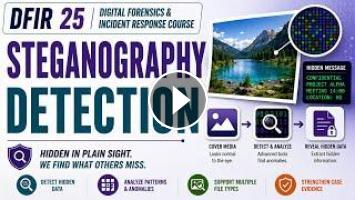
In this twenty-fifth episode of the Digital Forensics & Incident Response (DFIR) course by Uplatz, we explore how investigators detect steganography and identify hidden data inside images, audio files, documents and other digital media.
Key topics covered include:
• What is steganography?
• Steganography vs encryption
• Hidden data in digital files
• Image steganography
• Audio steganography
• Video steganography concepts
• Document-based steganography
• Least Significant Bit concepts
• Metadata-based hiding
• File append techniques concepts
• Hidden payloads
• Suspicious file sizes
• File structure anomalies
• Statistical analysis concepts
• Visual inspection
• Hex analysis
• File signatures
• Header and footer anomalies
• Entropy concepts
• Detecting embedded files
• Comparing original and modified files
• Steganalysis
• Steganography detection tools
• Password-protected hidden data
• File carving
• Metadata analysis
• Hash comparison
• Malware and steganography
• Command-and-control use cases
• Data exfiltration
• Insider threat scenarios
• Covert communication
• Anti-forensics techniques
• Identifying suspicious media files
• Forensic imaging
• Evidence preservation
• Validating extracted data
• Correlating hidden data with other evidence
• Common detection challenges
• Steganography investigation best practices
Unlike encryption, which makes data unreadable, steganography attempts to hide the fact that the data exists at all. A normal-looking image or audio file may therefore contain additional information without obvious visual or audible changes.
Investigators can look for inconsistencies in file structure, unusual metadata, suspicious file sizes or statistical patterns that suggest hidden content.
Specialized steganalysis tools can also examine media files for common hiding techniques and attempt to extract embedded data.
Steganography may appear in malware investigations, covert communication, insider threats or data exfiltration cases, so investigators should consider it when files appear unusual or do not match expected behavior.
This episode continues the Computer Forensics module of the Uplatz Digital Forensics & Incident Response course and prepares you for the next topic: anti-forensics techniques.
Subscribe to the Uplatz YouTube channel and follow the complete DFIR course to learn computer forensics, hidden data analysis, digital investigation and incident response step by step.
#DigitalForensics #DFIR #Steganography #Steganalysis #ComputerForensics #DigitalEvidence #IncidentResponse #CyberForensics #DataExfiltration #Cybersecurity #ForensicAnalysis #Uplatz
----------------------------------------------
In this twenty-fifth episode of the Digital Forensics & Incident Response (DFIR) course by Uplatz, we explore how investigators detect steganography and identify hidden data inside images, audio files, documents and other digital media.
Key topics covered include:
• What is steganography?
• Steganography vs encryption
• Hidden data in digital files
• Image steganography
• Audio steganography
• Video steganography concepts
• Document-based steganography
• Least Significant Bit concepts
• Metadata-based hiding
• File append techniques concepts
• Hidden payloads
• Suspicious file sizes
• File structure anomalies
• Statistical analysis concepts
• Visual inspection
• Hex analysis
• File signatures
• Header and footer anomalies
• Entropy concepts
• Detecting embedded files
• Comparing original and modified files
• Steganalysis
• Steganography detection tools
• Password-protected hidden data
• File carving
• Metadata analysis
• Hash comparison
• Malware and steganography
• Command-and-control use cases
• Data exfiltration
• Insider threat scenarios
• Covert communication
• Anti-forensics techniques
• Identifying suspicious media files
• Forensic imaging
• Evidence preservation
• Validating extracted data
• Correlating hidden data with other evidence
• Common detection challenges
• Steganography investigation best practices
Unlike encryption, which makes data unreadable, steganography attempts to hide the fact that the data exists at all. A normal-looking image or audio file may therefore contain additional information without obvious visual or audible changes.
Investigators can look for inconsistencies in file structure, unusual metadata, suspicious file sizes or statistical patterns that suggest hidden content.
Specialized steganalysis tools can also examine media files for common hiding techniques and attempt to extract embedded data.
Steganography may appear in malware investigations, covert communication, insider threats or data exfiltration cases, so investigators should consider it when files appear unusual or do not match expected behavior.
This episode continues the Computer Forensics module of the Uplatz Digital Forensics & Incident Response course and prepares you for the next topic: anti-forensics techniques.
Subscribe to the Uplatz YouTube channel and follow the complete DFIR course to learn computer forensics, hidden data analysis, digital investigation and incident response step by step.
#DigitalForensics #DFIR #Steganography #Steganalysis #ComputerForensics #DigitalEvidence #IncidentResponse #CyberForensics #DataExfiltration #Cybersecurity #ForensicAnalysis #Uplatz
----------------------------------------------
- Категория
- AI Инструменты

Комментариев нет.
Следующее
Auto
-
00:25

ESP32 Smoke Detection System
-
04:01
Real-Time Helmet Detection Using ESP32-CAM Tutorial | AI Traffic Monitoring + Alert System
-
04:32
Uncovering Hidden AI Search Traffic in GA4 | Tracking ChatGPT, Gemini & AI-Driven Visitors | Uplatz
-
08:35
DFIR 44 | AI-Generated Evidence and Deepfake Detection | Uplatz
-
08:02
How to Bypass AI Detection | Top 5 AI detector Triggers
-
06:28
Mastering Data Migration Strategies, Tools, and Risk Management | Uplatz
-
01:15
YouTube's NEW AI Disclosure & Detection System Explained!
-
02:50
Decopy AI Review: Best AI Text Detection in 2026? (Honest Review)
-
07:17
DFIR 42 | IoT Device Forensics | Uplatz
-
03:04
Drone News: Mavic 4 Pro Gets Shot, GoPro Sells 90% Ownership, UAS Sentry's New RID Detection Unit
-
05:33

ЗАРАБОТОК В ИНТЕРНЕТЕ | КРУТАЯ СХЕМА | FUNPAY
-
08:12

Пассивный Заработок 1000Р в День в Интернете на Телефоне Без Вложений
-
06:43

Как ЗАРАБОТАТЬ ШКОЛЬНИКУ в ИНТЕРНЕТЕ? Самые Легкие Способы Заработка
-
07:05

ЗАРАБОТОК В ИНТЕРНЕТЕ 2023 | Реальный заработок в интернете с вложением | Как заработать в интернете
-
05:49

ЗАРАБОТОК В ИНТЕРНЕТЕ 2023 | Реальный Заработок В Интернете С Вложением. Как Заработать В Интернете?
-
04:28

Схема заработка 2023 ! Зарабатываем в интернете онлайн сидя дома ! Заработок денег ! Деньги легко !
-
05:33

ЗАРАБОТОК В ИНТЕРНЕТЕ | КРУТАЯ СХЕМА | FUNPAY
-
06:43

Как ЗАРАБОТАТЬ ШКОЛЬНИКУ в ИНТЕРНЕТЕ? Самые Легкие Способы Заработка
-
14:53

Показываю Как Зарабатывать Деньги - Заработок В Интернете 2023 Рабочая Схема Для Заработка
-
14:12

Большой Заработок В Интернете С Выводом Рабочая Схема Заработка
 Загрузка...