

How do you transform a P&ID into a technically sound Control Narrative that a DCS engineer can implement, a process engineer can validate, and an operator can confidently use?
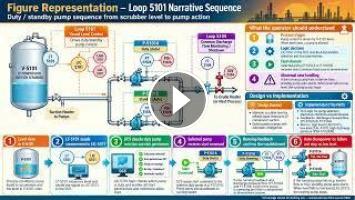
Welcome to this in-depth Process Control Narrative Workshop, where we examine Loop 5101 — LP Compressor Suction Scrubber Level-Driven Duty/Standby Pump Control, connecting process engineering design intent with real-world instrumentation, DCS logic, equipment protection, and operational philosophy.
The engineering challenge: When liquid condensate accumulates inside an LP compressor suction scrubber, inadequate removal may lead to liquid carryover, compressor damage, and costly production interruptions. Conversely, excessive pumping can cause low liquid inventory, cavitation, and pump damage.
How do we engineer an effective, reliable, and operationally safe control strategy?
In this technical session, we analyze the complete control philosophy around V-5101, LIC-5101, and P-5101A/B, demonstrating how a seemingly simple level-driven pump arrangement becomes an integrated control system involving process measurements, sequential logic, permissives, interlocks, alarms, and automatic standby changeover.
What You'll Learn
✅ Control Narrative Fundamentals: Engineering methodology for converting P&IDs into functional control descriptions, control logic, and implementation requirements.
✅ Process Control Philosophy: Vessel level measurement, condensate removal objectives, ON/OFF control, start/stop thresholds, hysteresis, and pump operating cycles.
✅ DCS Logic & Duty/Standby Selection: Automatic/manual selection, start permissives, running feedback, failure detection, and automatic changeover.
✅ Operational Modes: Initial plant commissioning and startup, restart after operation, normal steady-state control, manual operation, and degraded or crippled-mode operation.
✅ Shutdown & Abnormal Conditions: High/low vessel level, pump fail-to-start, running pump trips, loss of flow, discharge pressure abnormalities, and common-system failures.
✅ Engineering Calculations: Level scaling, vessel liquid inventory, condensate mass balance, pump capacity, operating hysteresis, response time, and sequence timer requirements.
✅ Control System Implementation: Initialization, mode transfer, interlocks, control priorities, signal validation, motor starter interfaces, and DCS configuration considerations.
✅ Operator Interface & Troubleshooting: DCS graphics, alarm handling, equipment status, diagnostic displays, and operator recovery actions.
✅ Process Safety & Safeguarding: Understanding the distinction between normal process control, operational interlocks, equipment trips, and independent instrumented protective functions.
✅ Engineering Verification: Functional logic descriptions, cause-and-effect relationships, FAT/SAT testing, and validation of normal and abnormal operating sequences.
Who Should Watch?
This workshop is designed for Process Design Engineers, Process Control Engineers, Instrumentation & Automation Engineers, DCS/PLC Engineers, Functional Safety Engineers, Operations Engineers, Maintenance Engineers, Commissioning Engineers, EPC/PMC Engineers, and engineering students developing expertise in industrial automation and process control.
Engineering Design Meets Practical Implementation
We explore not only WHAT the control system must accomplish, but also WHY the control strategy is required, HOW it should operate, and WHAT happens when individual components fail.
The illustrated equipment and instrument tags are representative training examples. Actual control settings, permissives, interlocks, and safeguarding actions must be validated against the project-specific engineering design.
Join Our Control Narrative Workshops
Need a professional facilitator for your Control Narrative development or technical review workshop?
I facilitate practical, engineering-focused Control Narrative and DCS Functional Design Workshops for multidisciplinary teams covering process control philosophy, P&ID interpretation, sequence development, instrumentation, operational requirements, and control system implementation.
Get in touch through the channel's contact information or leave a comment with "CONTROL NARRATIVE WORKSHOP" to discuss a dedicated workshop for your team.
Subscribe and follow the channel for more detailed technical sessions covering Process Control Basics, Control Narratives, P&ID Analysis, DCS Logic, Instrumentation Engineering, and Industrial Automation.
Understand the process. Define the control intent. Engineer the logic. Validate the results.
Top 15 YouTube Hashtags
#ControlNarrative #ProcessControl #DCS #InstrumentationEngineering #AutomationEngineering #ControlSystems #ProcessSafety #PID #PumpControl #DutyStandbyPumps #ControlLogic #PLCProgramming #CompressorProtection #EngineeringWorkshop #IndustrialAutomation
- Категория
- Схемы по заработку в интернете

Комментариев нет.
Следующее
Auto
-
15:52

Is Starlink Standby Mode Worth It When There's A Free Alternative?
-
00:04
Watch a Circular Knitting Machine Build Fabric Loop by Loop #Knitting #TextileTech #Manufacturing!!
-
IPF-4202: Excessive Surge Detection & Compressor Trip | SIS/IPF Control Narrative Workshop
-
33:17
Control Narrative Basics | Pump A Discharge Pressure Protection (Loop 5102)
-
13:03
Bitcoin Altcoins Stocks CRAZY PUMP RIGHT NOW!! Price PUMP Analysis BUUUULLRUN CONFIRMED
-
02:21
Single Phase submersible water pump Motor Starter Connection Power Control Wiring
-
26:55
Two-Point ON/OFF Control Logic & Hysteresis | Separator Process Control Narrative
-
Control Water Pump with Your Phone
-
00:37
Mini tractor video mini hand pump mini motor water pump science project #shorts #cartoon #tractor
-
Compressor Anti-Surge Control | Process Control Narrative Workshop | PCN-4101
-
05:33

ЗАРАБОТОК В ИНТЕРНЕТЕ | КРУТАЯ СХЕМА | FUNPAY
-
08:12

Пассивный Заработок 1000Р в День в Интернете на Телефоне Без Вложений
-
06:43

Как ЗАРАБОТАТЬ ШКОЛЬНИКУ в ИНТЕРНЕТЕ? Самые Легкие Способы Заработка
-
07:05

ЗАРАБОТОК В ИНТЕРНЕТЕ 2023 | Реальный заработок в интернете с вложением | Как заработать в интернете
-
05:49

ЗАРАБОТОК В ИНТЕРНЕТЕ 2023 | Реальный Заработок В Интернете С Вложением. Как Заработать В Интернете?
-
04:28

Схема заработка 2023 ! Зарабатываем в интернете онлайн сидя дома ! Заработок денег ! Деньги легко !
-
05:33

ЗАРАБОТОК В ИНТЕРНЕТЕ | КРУТАЯ СХЕМА | FUNPAY
-
06:43

Как ЗАРАБОТАТЬ ШКОЛЬНИКУ в ИНТЕРНЕТЕ? Самые Легкие Способы Заработка
-
14:53

Показываю Как Зарабатывать Деньги - Заработок В Интернете 2023 Рабочая Схема Для Заработка
-
14:12

Большой Заработок В Интернете С Выводом Рабочая Схема Заработка
 Загрузка...