

ATmega328 microcontrollers are widely used in Arduino-based embedded systems, but moving from an Arduino Uno prototype to a standalone microcontroller requires a clear understanding of the ATmega328 series and its bootloader-based programming approach.
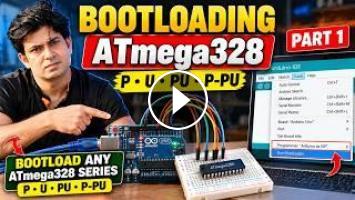
This is Part 1 of a 3-part technical tutorial series covering the ATmega328 series, bootloader programming, and the transition from Arduino Uno development to standalone embedded product development.
About This Tutorial
In this tutorial, you will understand why the Arduino Uno is primarily a development and prototyping platform and what changes when the ATmega328 microcontroller is used directly in a product.
The Arduino Uno is built around the ATmega328P family, but a professional embedded product does not necessarily need the complete Arduino Uno board. The required microcontroller, clock, power supply, programming interface, and supporting circuitry can be integrated into a custom PCB according to the application.
This tutorial establishes the foundation for the practical bootloader and programming work covered in Parts 2 and 3.
What You Will Learn
You will learn:
• What the ATmega328 series is and how it relates to Arduino Uno
• The difference between an Arduino Uno development board and the ATmega328 microcontroller
• Why Arduino Uno is commonly used for prototyping
• Why a standalone ATmega328-series microcontroller can be used in a final embedded product
• What a bootloader does in an ATmega328-based system
• Why bootloader programming is important when using a standalone ATmega328 microcontroller
• How the prototype-to-product transition works in embedded system development
• How the three-part ATmega328 bootloader and programming workflow is structured
Understanding the ATmega328 Series
The ATmega328 family includes different variants used in embedded applications, including devices such as ATmega328P, ATmega328PU, ATmega328PPU and ATmega328U.
Although these devices belong to the same ATmega328 family, their programming and development workflow can depend on the specific device and the tools or board definitions being used.
For this reason, the complete tutorial series covers the practical process rather than assuming that one Arduino Uno setting will work for every ATmega328-series device.
Part 1 focuses on understanding the overall concept and the transition from Arduino Uno development to standalone ATmega328-based product development.
The practical bootloader programming and device-specific configuration are covered in the following parts.
From Arduino Prototype to Embedded Product
During prototyping, an Arduino Uno provides a convenient development environment with the microcontroller, clock circuitry, USB interface, voltage regulation, reset circuitry and other supporting components already assembled on one board.
For a final product, an engineer may instead design a dedicated PCB containing only the hardware required by the application.
This approach allows the embedded system to be designed around the actual product requirements rather than around a general-purpose development board.
Who Should Watch This Tutorial
This tutorial is useful for:
• Electrical and Electronics Engineering students
• B.Tech and M.Tech students
• Diploma and Polytechnic students
• ITI students
• Embedded systems learners
• Arduino developers
• Microcontroller programming learners
• Engineering project developers
• Electronics hobbyists
• Engineers interested in product development
• Anyone learning ATmega328-series microcontrollers
Complete 3-Part Tutorial Series
Part 1 – ATmega328 Series Bootloader & Programming: Arduino Uno to Final Product
https://youtu.be/x5N_1xydrhw
Part 2 – Practical Bootloader Programming for ATmega328-series variants
https://youtu.be/DYxS1E0-u4Y
Part 3 – Programming ATmega328U using MiniCore
https://youtu.be/c46XMhlHVbA
Together, these tutorials provide a practical understanding of working with ATmega328-series microcontrollers beyond simply using an Arduino Uno development board.
Important Links
Full Tutorial Blog:
https://circuitsbazaar.com/atmega328-bootloader-programming-tutorial/
This is Part 1 of a 3-part technical tutorial series covering the ATmega328 series, bootloader programming, and the transition from Arduino Uno development to standalone embedded product development.
About This Tutorial
In this tutorial, you will understand why the Arduino Uno is primarily a development and prototyping platform and what changes when the ATmega328 microcontroller is used directly in a product.
The Arduino Uno is built around the ATmega328P family, but a professional embedded product does not necessarily need the complete Arduino Uno board. The required microcontroller, clock, power supply, programming interface, and supporting circuitry can be integrated into a custom PCB according to the application.
This tutorial establishes the foundation for the practical bootloader and programming work covered in Parts 2 and 3.
What You Will Learn
You will learn:
• What the ATmega328 series is and how it relates to Arduino Uno
• The difference between an Arduino Uno development board and the ATmega328 microcontroller
• Why Arduino Uno is commonly used for prototyping
• Why a standalone ATmega328-series microcontroller can be used in a final embedded product
• What a bootloader does in an ATmega328-based system
• Why bootloader programming is important when using a standalone ATmega328 microcontroller
• How the prototype-to-product transition works in embedded system development
• How the three-part ATmega328 bootloader and programming workflow is structured
Understanding the ATmega328 Series
The ATmega328 family includes different variants used in embedded applications, including devices such as ATmega328P, ATmega328PU, ATmega328PPU and ATmega328U.
Although these devices belong to the same ATmega328 family, their programming and development workflow can depend on the specific device and the tools or board definitions being used.
For this reason, the complete tutorial series covers the practical process rather than assuming that one Arduino Uno setting will work for every ATmega328-series device.
Part 1 focuses on understanding the overall concept and the transition from Arduino Uno development to standalone ATmega328-based product development.
The practical bootloader programming and device-specific configuration are covered in the following parts.
From Arduino Prototype to Embedded Product
During prototyping, an Arduino Uno provides a convenient development environment with the microcontroller, clock circuitry, USB interface, voltage regulation, reset circuitry and other supporting components already assembled on one board.
For a final product, an engineer may instead design a dedicated PCB containing only the hardware required by the application.
This approach allows the embedded system to be designed around the actual product requirements rather than around a general-purpose development board.
Who Should Watch This Tutorial
This tutorial is useful for:
• Electrical and Electronics Engineering students
• B.Tech and M.Tech students
• Diploma and Polytechnic students
• ITI students
• Embedded systems learners
• Arduino developers
• Microcontroller programming learners
• Engineering project developers
• Electronics hobbyists
• Engineers interested in product development
• Anyone learning ATmega328-series microcontrollers
Complete 3-Part Tutorial Series
Part 1 – ATmega328 Series Bootloader & Programming: Arduino Uno to Final Product
https://youtu.be/x5N_1xydrhw
Part 2 – Practical Bootloader Programming for ATmega328-series variants
https://youtu.be/DYxS1E0-u4Y
Part 3 – Programming ATmega328U using MiniCore
https://youtu.be/c46XMhlHVbA
Together, these tutorials provide a practical understanding of working with ATmega328-series microcontrollers beyond simply using an Arduino Uno development board.
Important Links
Full Tutorial Blog:
https://circuitsbazaar.com/atmega328-bootloader-programming-tutorial/
- Категория
- Схемы по заработку в интернете

Комментариев нет.
Следующее
Auto
-
03:01

Measure Solar Panel Voltage & Current with Arduino | ACS712 + Voltage Divider #shorts
-
01:52
Arduino UNO R3 & Multi-Function Shield & AI 3 августа 2026 г.
-
00:34
Part - 8 Compact 5V Power Supply for Arduino Projects
-
08:18
How to Teach Arduino & Circuits Using Tinkercad
-
00:55
Paper 2 Final Advice - Part 1
-
00:11
¿Os pasa? Uno de los peligros de teletrabajar
-
Дребезг Кнопки на ATtiny13. 4 Готовых Решения! #attiny13 #arduino #arduinoproject #soldering #diy
-
11:12
What Is Ladder Logic in PLC Programming?
-
00:06
Arduino Automatic Door Light Switch
-
00:50
Блокировка в прибыль #айти #icodetips #программирование #programming #ии
-
05:33

ЗАРАБОТОК В ИНТЕРНЕТЕ | КРУТАЯ СХЕМА | FUNPAY
-
08:12

Пассивный Заработок 1000Р в День в Интернете на Телефоне Без Вложений
-
06:43

Как ЗАРАБОТАТЬ ШКОЛЬНИКУ в ИНТЕРНЕТЕ? Самые Легкие Способы Заработка
-
07:05

ЗАРАБОТОК В ИНТЕРНЕТЕ 2023 | Реальный заработок в интернете с вложением | Как заработать в интернете
-
05:49

ЗАРАБОТОК В ИНТЕРНЕТЕ 2023 | Реальный Заработок В Интернете С Вложением. Как Заработать В Интернете?
-
04:28

Схема заработка 2023 ! Зарабатываем в интернете онлайн сидя дома ! Заработок денег ! Деньги легко !
-
05:33

ЗАРАБОТОК В ИНТЕРНЕТЕ | КРУТАЯ СХЕМА | FUNPAY
-
06:43

Как ЗАРАБОТАТЬ ШКОЛЬНИКУ в ИНТЕРНЕТЕ? Самые Легкие Способы Заработка
-
14:53

Показываю Как Зарабатывать Деньги - Заработок В Интернете 2023 Рабочая Схема Для Заработка
-
14:12

Большой Заработок В Интернете С Выводом Рабочая Схема Заработка
 Загрузка...